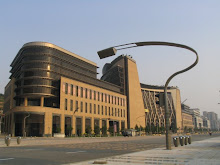
Monday, December 14, 2009

PUTRAJAYA


BEAUTIFUL PUTRAJAYA: LEGACY OF TUN DR MAHATHIR


I have so much things to write about Putrajaya. Putrajaya created its own paragraph in Malaysian history. It relates to my own life history. My short stay (Sep 02- Jan 04) in MoF, Precint 2 was really a memorable patch in my life. After PM Department, MoF was among the pioneers of Putrajaya.

PM Mahathir who was also the Minister of Finance wanted MoF office to move from Kompleks Kerajaan Jalan Duta to its permanent complex at Boulevard Putrajaya, Precinct 2 eventhough the building was not really ready to be occupied.

Putrajaya is a thoroughly modern and vibrant city located just south of KL. This is a model township that has been constructed with detailed planning, innovative urban design and great respect for the environment and it serves as the new federal administrative centre of Malaysia.

The relocation of several Government offices to this vibrant city is to ease the overcrowding and congestion of KL city.

It is also to ensure that Kuala Lumpur will have adequate supply of land to continue developing as Malaysia's principal business and financial centre. However, Kuala Lumpur still serves as Malaysia's national and legislative capital.

The vision to have a new Federal Government Administrative Centre to replace Kuala Lumpur surfaced in the late 1980s. A 4,930 hectare lush forest area in southern Prang Besar estate in Selangor was identified and later renamed Putrajaya in honour of Malaysia's first Prime Minister Tunku Abdul Rahman Putra Al-Haj for his invaluable contribution to the nation.

Putrajaya is a city with a vision and heritage for the country's present and future generations. Its beautifully landscaped roads and parks as well as modern buildings are clearly reflected in the duality of the project theme "Garden City, Intelligent City". Of the city's total land area, about 37.5% is being developed into parks, lakes and wetlands while the remaining for Government offices, commercial and residential areas, public utilities and amenities. The centerpiece of the city is a 400 hectare manmade lake.

This city is also home to some of the most beautiful architectural works in Malaysia. Facing the scenic Lake, we have the Putra Mosque, which is arguable the city's most distinctive landmark and one of the most modern mosques in the world.


Then we have the Perdana Putra, (Prime Minister's Office) which overlooks the Lake, the Mosque and Dataran Putra.


Putra Perdana: daytime (above) and at night (below)


There are 9 bridges in this city. They are the Seri Perdana Bridge, Seri Putra Bridge, Seri Wawasan Bridge, Seri Bakti Bridge, Seri Saujana Bridge, Seri Bestari Bridge, Seri Setia Bridge, Seri Gemilang Bridge and the Monorail Suspension Bridge.


Seri Gemilang Bridge


In my opinion, the one that stands out here is the Seri Wawasan Bridge, which is an amazing architectural structure. You should see it at night when the bridge is all lit up. Absolutely beautiful!

Seri Wawasan Bridge

And of course, not forgetting one of the most prominent landmarks here, the Putrajaya International Convention Centre, also known as PICC. This convention centre is HUGE! and I mean HUGE as in MASSIVE!

PICC has become one of the most favoured conference venue for high security risk events, hosted by the private or government sector. PICC has had many important guest including foreign head of states, heads of government and important corporate personalities such as the world's richest man, Bill Gates. Due to its strategic location on the top of the hill, facing the beautiful lakes, it has also become one of the most popular places and sites for film shootings.

This city is truly a magnificent, vibrant and beautiful city. So, if you visit Malaysia, be sure to drop by at Putrajaya, the "Garden City, Intelligent City".


Putrajaya was the brainchild of a former Prime Minister Tun Dr Mahathir Mohammad who was in power between July 1981 till Oct 2003. On 1st Feb 2001, Putrajaya was made a Federal Territory, the third FT after Kuala Lumpur (1974) and Labuan (1984) .


The city is situated within the Multimedia Super Corridor, beside the also newly developed Cyberjaya. The development started in 1995 and today major landmarks are completed and the population is expected to grow in the relatively new city.

History and Design

The Federal Government negotiated with the state of Selangor on the prospect of another Federal Territory and in the mid-1990s, the Federal government paid a substantial amount of money to Selangor for approximately 11 320 acres (46 km²) of land in Prang Besar, Selangor. As a result of this land purchase, the state of Selangor now completely surrounds two Federal Territories within its borders, namely KL and Putrajaya.

Planned as the garden and intelligent city, 38% of the area is reserved for green areas by emphasizing the enhancement of natural landscape. A network of open spaces and wide boulevards were incorporated to the plan. Construction began in August 1995 and it was Malaysia's biggest project and one of Southeast Asia's largest with estimated final cost of US$ 8.1 billion. The entire project was designed and constructed by Malaysian companies with only 10% of the materials imported.


The Asian financial crisis of 1997/1998 had somewhat slowed the development of Putrajaya. In 1999, 300 staffs of the Prime Minister's office were shifted to Putrajaya and the remaining government servants moved in 2005. On February 1, 2001 Tun Dr. Mahathir declared Putrajaya as a Federal Territory with the ceremony of handing over Putrajaya township from the Selangor state authorities.


In 2002, a high speed rail link called KLIA Transit (ERL) was opened, linking Putrajaya to both Kuala Lumpur and KLIA in Sepang. However, construction of the Putrajaya Monorail which was intended to be the city's metro system, was suspended due to costs. One of the monorail suspension bridges in Putrajaya remains unused.

In 2007, the population of Putrajaya was estimated to be over 30,000, which comprised mainly government servants.


Monday, December 7, 2009

JUBILEE EMAS TOHARUDIN


JUBILEE EMAS

Hari ini 22 Nov 2009, genap usiaku 50 tahun. My Golden Jubilee.

Dilahirkan pada 22 November 1959 di Kg Parit Lapis Mahang, Mk X, Senggarang, Batu Pahat, Johor (anak keempat). Ayahku bernama Hj Abd Rashid bin Hj Tahir (Isa) bin Ibrahim, ibuku bernama Umikelsom binti Hj Mustapa bin Pajoyo. Nenek sebelah ayah bernama Manisah bt Shafie manakala nenek sebelah ibu bernama Suminah bt Kasan. Adik beradikku, yang sulong bernama Md Jahrom (7-6-1951), kedua Siti Rahimah (7-7-1954), ke3 Khamim (18-4-1957).

Tahun 1962 keluarga kami pindah ke rumah yang ada sekarang- mengadap ke jalan raya. Adikku Noradzim (anak kelima) dilahirkan (3-1-1963), Rakhiman (anak ke6) dilahirkan (13-10-1965). Pada tahun 1966 aku masuk sekolah rendah, Sek Keb Seri Rejo Sari. Adikku Khairiah (anak ke7) dilahirkan (13-5-1968).

Tahun 1970, aku menduduki Peperiksaan Penilaian Dj 5 (mendapat 3A, 1B, 1C) dan menjadi pelajar terbaik tahun itu. Adik bungsuku, Aminin dilahirkan pada 3-2-1971. Pada tahun 1972 kakakku Siti Rahimah (18) berkahwin dengan Hamzah (almarhum 2006).

Aku masuk Sekolah Menengah Tunku Mahmood Iskandar (STMI), Pt Saidi pada tahun 1972. Pada tahun 1974 aku mengambil SRP (dapat A11) dan abang sulungku, Md Jahrom (23) berkahwin dengan Sharifah Zainah (Kak Enah) pada tahun 1975.


Aku lulus SPM pada tahun 1976 dan mendapat Pangkat 1 Agg 16. Masuk Tingkatan 6 Rendah di SDBL (beberapa minggu sahaja) kemudian terpilih untuk memasuki ke asrama penuh di Sek Alam Shah, Cheras KL. Tetapi aku meninggalkan SAS untuk masuk ke UTM (Kursus Integrasi Senibina) pada bulan Mei 77- tinggal di asrama UTM Jalan Gurney (sekarang Jalan Semarak). Pada tahun 1979 aku gagal meneruskan pengajian di UTM. Kegagalan besar pertama dalam hidupku.


Pada bulan April 1980 aku masuk Sekolah Pegawai Kedet (SPK) Port Dickson bagi Pengambilan Tauliah Jangka Pendek (TJP) ke 37. Aku menamatkan latihan pada penghujung Dis 80, tidak ditauliahkan kerana perlu melapor ke Sekolah Penerbangan TUDM sebagai Pegawai Kedet Udara. Mula-mula dihantar ke Pulatibang I, TUDM Alor Setar tetapi kemudiannya dihantar untuk menjalani latihan di Pulatibang II, TUDM Kluang untuk menjalani latihan asas penerbangan helikopter. Pada bulan Mei 1981 aku gagal latihan penerbangan. Kegagalan besar kedua dalam hidupku.

Aku ditauliahkan sebagai Lt Muda (Udara) mulai 1 Julai 1981 di pejabat Komandan TUDM Kluang. Pemakaian pangkat disempurnakan oleh Pemangku Komandan, Mej (U) Abdul Razak Abdul Aziz (bersara Mej Jen TUDM pada tahun 2005) dan ditumpangkan ke Cawang Logistik, ditumpangkan ke Cawang Bekalan.


Selepas mengikuti kursus pendek (sebulan) Pergerakan Udara di SEKLOG TUDM Kinrara, aku ditukarkan ke TUDM Kuching pada bulan Okt 1981 selama 2 tahun 6 bulan. Sejarah 'ragging' terburuk dalam TUDM di Mes Angkasanuri, dimana seorang juruterbang muda bernama LtM Sukhudev Dass telah mati. Sebagai pegawai muda yang pertama kali bertugas di Unit operasi, aku melalui banyak 'dunia' baru di sini.


Aku bertunang dengan Adibah pada 16 Ogos 1982.


Aku mengikuti Kursus Asas Pengurusan Pegawai Logistik 22/83 di TUDM Kinrara dari Apr hingga Okt 1983. Sebaik sahaja menamatkan kursus asas Logistik, aku melangsungkan perkahwinan dengan Adibah pada 16 Okt 1983.


Setelah tamat kursus asas aku ditukarkan ke TUDM Kuantan mulai 21 Okt 1983. 3 bulan dari tarikh melapor di TUDM Kuantan, aku terpilih mengikuti Kursus Asas Pegawai Kelengkapan di Sekolah Kor Kelengkapan, Batu Kantonmen selama 3 bulan. Bulan Ogos 1984, ditumpangkan ke Pulatibang 3 sebagai Ketua Flt Logistik. Lt Kol Aziz Iskandar (my Commandant)....... di mana dia sekarang?


Pada 27 Ogos 1984 Muhammad Hafeez Firdaus dilahirkan di Hospital Tengku Ampuan Afzan, Kuantan. Kereta pertamaku (second hand je) ialah Nissan Pulsar CQ 5300. Dinaikkan ke pangkat Lt (Udara) pada 24 Januari 1985, disempurnakan oleh Pemangku Komandan, Mej Shubli bin Ismail (beliau meninggal dunia dalam kemalangan pesawat MB-339A pada 1 Jun 1985).

Nur Fairiza Fazeera dilahirkan di Hospital Tengku Ampuan Afzan, Kuantan pada 23 Oktober 1985.

Aku dipilih mengikuti kursus Diploma in Business Studies, ITM Shah Alam ) bermula pada bulan Jun 1986 dan duduk di Sek 17, Shah Alam (sehingga tahun 1993). Semasa di Shah Alam aku berpengalaman menjadi Imam, Pembantu Amil dan Setiausaha Surau Al Amin Sek 17. Graduat dari ITM dengan Diploma in Business Studies , ITM Shah Alam (26 Okt), melapor ke Markas Pemerintahan Pertahanan Udara ( Markas HANUD) dan dinaikkan ke pangkat Kapten TUDM (sebenar) berkuatkuasa pada 1 Ogos 1989. Pemakaian disempurnakan oleh Panglima, Mej Jen Dato' Abdul Ghani Aziz.

Mengikuti Kursus Pegawai Skuadron 22/90 di ITU Kinrara pada bulan Feb hingga Mei 1990. Aisyahnur Abid dilahirkan di Hospital Tengku Ampuan Rahimah, Klang (8 Mac 1990). Aku tukar kereta (second hand juga) kepada Proton Saga 1.5 –WBK 1718. Atikah Nur Ezzaty (anakku ke 4) dilahirkan di Shah Alam (di rumah sewa Jln 17/14A) pada 6 Jun 1991.

Pada tahun 1991 aku dapat pengalaman bertugas sebagai LO (Log) dalam Ex-Elang Malindo di Medan, Indonesia. Ditukarkan ke DTU Latih sebagai PS 2 Latih (Kewangan) pada 27 Dis 1991.

Aku berpindah rumah dari Sek 17, S/Alam ke OMQ 121 Kem KEMENTAH pada 28 Jan 1993. Ditukarkan ke Bahagian Materiel sebagai PS 2 SISMAT C (Sumber Manusia) mulai 1 Jun 1993 dan dinaikkan ke pangkat P/Mejar TUDM berkuatkuasa 01 Jun 1993. Pemakaian disempurnakan oleh Brig Jen Abdul Rahman bin Rais, APTU Materiel (bersara 1996 dan meninggal dunia pada 18 Sep 2004).

Aku sekali lagi terpilih untuk mengikuti Kursus Diploma Lanjutan Pengajian Perniagaan -ADBS(HRM di ITM Shah Alam.

Aktif dalam PIBG SKDTHO mulai 1995 sebagai AJK, kemudian Timbalan Pengerusi dan Pengerusi sehingga tahun 1999. Anakku ke5, Muhammad Heikal Fawwaz dilahirkan di OMQ 121, Blok 4501, Lorong Golok, Kem KEMENTAH (26 Mei 1995).

Menamatkan kursus di ITM pada Jun 1989 dan dianugerahkan ijazah Sarjana Muda (Kepujian)(Pengurusan Sumber Manusia) Kelas Dua Tinggi, juga menerima anugerah Graduan Terbaik Kursus BBA(Hons)(HRM).

Ditukarkan ke Bahagian Materiel, MTU sebagai PS 2 SISMAT B kemudian memangku PS 1 SISMAT. Menerima Anugerah Khidmat Cemerlang pada tahun 1997. Kali pertama aku dapat ke luar negara (bukan Asia Tenggara) ialah pada Mac 1997 menyertai PDI Tac Radio Comm di Chandigarh, India.

Tahun 1997, aku dikurniakan pingat Ahli Mangku Negara ( AMN) (oleh SPBYDP Agong X: Tuanku Jaafar).


Pada bulan Nov 98, terpilih mengikuti PDI PSR di Rome, Italy (berpeluang melawat Pisa, San Marino dan La Spezia)- perjalanan ulung ke Eropah.

Tahun 1999 aku mengikuti pengajian setahun di Maktab Turus AT. Turut mendapat Diploma Pengajian Strategik dan Pertahanan, Universiti Malaya. Lawatan ke ke Songkhla & Haatyai, Thailand. Aku tukar kereta (pertama kali merasa kereta baru), Proton Wira GLi 1.5 bernombor BFR 1544 (government loan). Setelah menamatkan kursus di MTAT, aku ditukarkan ke Kementerian Kewangan (Kompleks Kerajaan Jalan Duta) untuk menjawat jawatan Pegawai Khas TUDM di Bahagian Perolehan mulai 27 Dis 2000.

Nurul Azyan Syafiqah dilahirkan di Hospital KL pada 4 Mei 2000. Pada bulan Okt 2000 mengikuti Project Review Meeting Super Lynx RMN Heli Project di Yeovil (Sommerset) & London, UK (pertama kali dapat ke UK).

Pada tahun 2001 aku beli motorsikal Modenas Kriss (2nd hand) (kerja kat Putrajaya, tak larat duit minyak kereta). Pada bulan Jan 2001- ke Tucson, Arizona, USA- (via Los Angeles) tugas mambawa pulang Global Express 9007- balik singgah di Barcelona (night stop) & Pulau Maldives (refuelling).Pada bulan Jul 2001, ke Toronto, Canada (acceptance check GE 9096), berpeluang melawat ke premis SPAR Aerospace dan melancong ke Niagara Falls. Pada tahun ini juga aku mula mengikuti pengajian luar kampus di UKM (Sarjana Pentadbiran Perniagaan).

Tahun 2002, Heikal masuk tahun 1 SKDTHO manakala Hafeez dan Fazeera ambil PMR di SMA Wawasan. Aisyah masuk Tingkatan 1, di SMDTHO manakala Hafeez dan Fazeera berpindah ke SMAR Nahdatul Hasanah, Melele, Kodiang, Kedah (masuk Tkt 4). Pada tahun ini juga KemKew berpindah ke Kompleks Kementerian Kewangan yang baru di Presint 2 Putrajaya pada Sep 2002. Aku juga berpeluang ke Milan, Italy (via Rome) untuk menghadiri Project Review Helikopter A109M JBPM pada Nov 2002 (berpeluang melancong ke Venice dan balik singgah London.)

Tahun 2003, aku beli motorsikal Modenas Jaguh –PUTRAJAYA 1959 (jual Kriss). Pada tahun ini aku menerima ijazah Sarjana Pentadbiran Perniagaan (MBA), Universiti Kebangsaan Malaysia dalam Konvokesyen ke 31 pada 18 Ogos 2003.

Pada bulan Feb 2004, aku melapor ke MTU-Materiel (SISMAT) dan dinaikkan ke pangkat P/Lt Kol TUDM berkuatkuasa pada 1 Feb 2004, disempurnakan Timbalan PTU, Lt Jen Dato’ Azizan bin Ariffin. Pada Jun 2004, aku menghadiri Logistics Seminar di Singapura. Mulai bulan Mei aku mula membuat part time tutor di OUM (PPT Shah Alam Sek 7).

Aku dipilih mengikuti delegasi ATM dalam Logistics Working Group Meeting di Bandar Seri Begawan, Brunei Darussalam. Pada bulan Ogos 2005, Menghadiri Pacific International Logistics Seminar di Hickam AFB, Hawaii (via Singapura & Tokyo).


Sepanjang tahun 2004-2006 aku diberi tugas sebagai Panel Pengadil Anugerah Kualiti PTU, Panel Pengadil Anugerah Maal Hijrah KEMENTAH, Panel Pengadil Pertandingan Esei Bahasa Inggeris KEMENTAH. Aku bertukar ke jawatan PS 1 Kontrak mulai 10 Okt 2005. Menerima pingat Kesatria Angkatan Tentera (KAT) pada 15 Nov 2005 oleh YDPA XII Tuanku Syed Sirajuddin. Aku membeli kereta kedua (baru), Naza Citra –WNN 1959 (anak 6, Proton Wira dah tak muat lagi dahhh).

Aku terpilih mengikuti lawatan ke Indonesia (Jakarta, Bandung, Jogjakarta) untuk Program Pertukaran Pegawai TUDM-TNIAU pada bulan Mei 2006. Aku mengetuai tugas Pre-Acceptance Check untuk Camera F5 AK270 di ROI Barrington, Illinois, USA dari 14 hingga 21 Okt 2006.

Tahun 2007, Hafeez menerima Diploma Tahfiz Qur’an (Darul Qur’an) manakala Fazeera menerima Diploma Pengajian AlQur’an dan Sunnah ( KUIS).

Aku ditukarkan ke MLU (sebagai PS 1 Pembaikan)- mulai 01 Apr 07). Terpilih mengikuti tim PDI SU30MKM di Irkutsk/Moscow (Russia) juga majlis Roll out Ceremony Pesawat SU30MKM (13 Mei – 26 Mei 07). Turut terpilih ke UK (London, Bristol, Ansty & RAF Marham) untuk tugas Lawatan di Rolls-Royce Facilities (28 Mei – 1 Jun 07). Dipilih sebagai Tokoh Wira Maal Hijrah 2007 KEMENTAH.


Sekali lagi ke UK (Ansty) bagi tugas Acceptance Test Viper Engine (9-14 Dis 08)- lawatan ke Museum Madame Tussauds). Mula memangku jawatan Ketua Staf Khidmat, MLU mulai 14 Jul 08. Tahun ini juga aku membeli kereta (second hand) Perodua Kancil –WLX 7587 (untuk Fazeera- diala bayar ansuran bulanan).

Tahun 2009, aku ke Bristol, UK -untuk tugas Programme Review Meeting (PRM) Adour Engine (23-27 Mac 09). Secara rasmi ditukarkan ke jawatan KSK mulai 1 Jun 09. Lawatan ke Lytham, UK (London) untuk tugas JPRM Hawk/BAe, dan lawatan tak rasmi ke Kearsly di Stansted, Martin Bakers di Denham, Oxbridge dan Vector Aerospace di Croydon (28 Jun – 4 Jul 09).

Dinaikkan ke pangkat Pemangku Kolonel TUDM pada 30 Jul 09 dan berkuatkuasa pada 01 Jun 2009.


Sunday, December 6, 2009

MAHATHIR MOHAMMAD


TUN DATO' SERI DR MAHATHIR BIN MOHAMMAD
DK(Joh) DK(Perlis) DK(Kel) DK(Ked) DK(Sel) DKNS DUK SMN SSAP SPCM SSMT SPNS SPMJ SPMS DSBS DUNM DUPN SPDK DP DSDK PIS

MY NOTE
"YOU MAY FIND A LOT OF ARTICLES AND PICTURES ABOUT MAHATHIR IN THE MAGAZINES, JOURNAL, WEBSITES, BLOGS, NEWSPAPERS ETC. INSIDE HERE, ALL THE ARTICLES WERE CUT AND PASTED. IN ADDITIONS I WILL WRITE (IN MY ON WAY) ABOUT MAHATHIR BASED ON MY OWN POINT OF VIEWS"

my view "THE BIGGEST CONTRIBUTION OF MAHATHIR TO MALAYSIA IS THE DISMISSAL OF ANWAR IBRAHIM FROM HIS POSITION AS DPM IN 1998"


SYNOPSIS

Mahathir bin Mohamad, (born 20 Dec 1925). Malaysian political leader. A doctor by training, he first entered parliament in 1964 and rose in the United Malays National Organization (UMNO), but lost his seat and was expelled from UMNO in 1969 after criticizing Prime Minister Tunku Abdul Rahman. Subsequently readmitted into UMNO, he was reelected to parliament in 1974 and held several ministerial posts in the 1970s, including Deputy Prime Minister beginning in 1976. Prime minister of a UMNO-led National Front coalition government after 1981, Mahathir sought to make Malaysia an industrial nation and develop Malay businesses, and promoted non individualistic "Asian values" while often denouncing the West. Although Malaysia made enormous and rapid economic progress under Mahathir, political stability was maintained by not tolerating dissent and restricting political freedoms, and his government was denounced for human-rights abuses. He retired as Prime Minister in 2003. Out of office he has continued to be outspoken and sometimes critical of the Malaysian government.

Summary:
Expelled from UMNO : 1969
Rejoined UMNO : 1972
Appointed a Senator: 1973
Elected MP and Minister of Education: 1974
Appointed as DPM: 1976
Appointed as PM: 1981

What 'BIG CHANGES' he had done for the country, within 22 years as a PM?
  • Synchronised National Time (1981)
  • KL international Airport, Sepang (KLIA) (1990-1998)


    Mega Project: KLIA Sepang

  • Petronas Twin Tower (1992-98)- world tallest twin tower, world tallest building 1998-2004)- 451.9m and 88 stories.
  • North-South Highway (JB to Bukit Kayu Hitam)


    NORTH-SOUTH HIGHWAY

  • Jambatan Pulau Pinang (launched 1985)


    PENANG BRIDGE

  • Pelabuhan Tanjung Pelepas, Johor (PTP)


    TANJUNG PELEPAS PORT

  • Langkawi International Maritime and Aerospace Exhibition (LIMA) (1991)
  • National Car:Proton Saga (1985)
  • Multimedia Super Corridor (MSC)
  • Putrajaya (Goverment Administrative Center)(1995-2001) development ongoing.


    PUTRAJAYA
  • Cyberjaya
  • Sepang International Circuit (SIC)
  • Bakun Dam (1994-2010)
  • FT Labuan (16 Apr 1984)
  • FT Putrajaya (1 Feb 2001)

Other Mahathir's Legacy:

  • Changed the Sultan Johore into normal human being
  • Amendment to the Malaysian constitution (the immunity of the Rulers)
  • Dismissed Anwar from the next step to the Premier seat.
  • Interfered judicial affairs
  • Dollar pegging 1998
  • The champion and idola of third world countries (SID/LID, CHOGM, NAM, OIC)

He had 3 DPMs throughout his tenure as PM:
  • Dato' Musa Hitam (born in Johor Bahru: 18 Apr 1934- became DPM: 1981 and resigned in 1986, now Tun)
  • Encik Ghaffar Baba (born in Melaka: 18 Feb 1925, appointed DPM: 1986, defeated by Anwar in party election 1993- died in 23 Apr 2006, Tun)
  • Anwar Ibrahim (born in Permatang Pauh, PP: 10 Aug 1947, appointed as DPM dismissed on 2 Sep 1998)
  • Abdullah Ahmad (born in Penang: 26 Nov 1939, appointed as DPM: Jan 1999 and succeeded Mahathir as PM on 31 Oct 2003)


Mahathir with his beloved wife: Dr Siti hasmah


BIRTH PLACE


The wooden attap house was bought by Mohamad Iskandar when he wanted to marry off his children. It was built in 1900. When he bought the house, the house has only one room with no electricity. It has wooden flooring and the ceiling was made from white cloth. Mahathir was born here on 20th December 1925. He lives there until he was married and moved to his own house in Titi Gajah. Even then Mahathir will always commute to this house to visit his mother.

A visit to Mahathir Mohamad's birth place will give you a different perspective of the life of this revered leader. He was born in Alor Star on Dec 20, 1925 at No 18 Lorong Kilang Ais, off Jalan Pegawai. His home has seen been designated a historical building and was restored by the National Archives in 1992.


SHORT BIOGRAPHY

Born on 20 December 1925 in Alor Setar, the capital of the State of Kedah, Tun Dr. Mahathir did his early and secondary education in his home town. In 1947, he gained admission into the King Edward VII College of Medicine in Singapore.

Upon graduation, he joined the Malaysian government service as a Medical Officer. He left in 1957 to set up his own practice in Alor Setar.

Tun Dr. Mahathir has been active in politics since 1945. He has been a member of the United Malays National Organisation (UMNO) since its inception in 1946.

He was first elected as a Member of Parliament following the General Elections in 1964. However, he lost his seat in the subsequent General Election in 1969. Owing to his keen interest in the country's education, he was appointed Chairman of the first Higher Education Council in 1968, Member of the Higher Education Advisory Council in 1972, Member of the University Court and University of Malaya Council, and Chairman of the National University Council in 1974.

In 1973, Tun Dr. Mahathir was appointed a Senator. He relinquished this post in order to contest in the 1974 General Elections where he was returned unopposed. Following the elections, Tun Dr. Mahathir was appointed the Minister of Education.

In 1976, Tun Dr. Mahathir was made Deputy Prime Minister in addition to his Education portfolio. In a Cabinet reshuffle two years later, he relinquished the Education portfolio for that of Trade and Industry. As Minister of Trade and Industry, he led several investment promotion missions overseas. Tun Dr. Mahathir was elected as one of the three Vice Presidents of UMNO in 1975. In 1978, he won the Deputy President seat and in 1981, he was appointed President of the party. He was returned unopposed as President in 1984.

In the 1987 party elections, Tun Dr. Mahathir defeated his challenger to retain the Presidency and in 1990 and 1993, he was again returned unopposed as party President. Under his leadership, the ruling party Barisan Nasional (National Front) won landslide victories in the 1982, 1986, 1990, 1995 and 1999 General Elections.

Tun Dr. Mahathir is married to a doctor, Tun Dr. Siti Hasmah bt Mohd Ali, and they have seven children Marina, Mirzan, Melinda, Mokhzani, Mukhriz, Maizura and Mazhar.


Loving Couple: Mahathir and Siti Hasmah


Mahathir and family

Mahathir and his extended family


Tun Dr. Mahathir stepped down as Prime Minister on October 31st 2003 and succeeded by Datuk Seri Abdullah Badawi.


Tearing Moment: Immidiately after Mahathir announcing his intention to resign as the UMNO President
and Prime Minister of Malaysia (in UMNO General Assembly 2002)


Issues and Controversies

Major Constitutional Changes.
In 1983 and 1991, he took on the federal and state monarchies, removing the royal Veto and royal immunity from prosecution. Prior to this amendment of the law, royal assent was required in order for any bill to pass into law. With effect of this amendment, approval by Parliament could be legally considered as royal assent after a period of 30 days, notwithstanding the views of the monarchs.

Mahathir and Tuanku Iskandar (then 8th Agong)

In 1988 when the future of the ruling party UMNO was about to be decided in the Supreme Court (it had just been de-registered as an illegal society in the High Court), he was believed to have engineered the dismissal of the Lord President of the Supreme Court, Salleh Abas, and three other supreme court justices who tried to block the misconduct hearings. The series of incidents in 1988 has been widely viewed as the end of the Malaysian judiciary's independence from the executive.

Economic Policies.
During his term in office, Mahathir turned Malaysia into a regional high-tech manufacturing, financial and telecommunications hub through his economic policies based on corporate nationalis, known as the various "Malaysia Plans" which set out the government middle-term objectives.

These policies with strong Keynesian tendency remained in effect almost to the end of his tenure in office.His pet projects have included Perwaja Steel, an attempt to emulate South Korea and Japan, the Proton car company and ASTRO, a satellite television service.

Mahathir credited with spearheading the phenomenal growth of the Malaysian economy, now one of the largest in South East Asia. Growth between 1988 and 1997 averaged over ten percent and living standards rose twentyfold, with poverty relatively almost eradicated and social indicators such as literacy levels and infant mortality rates becoming almost on par with developed countries.

During this period, Mahathir embarked on various large scale national projects, such as the North-South Expressway, MSC, the planned capital city of Putrajaya, Johor's PTP, KLIA, Bakun Dam and the PETRONAS Twin Towers. While such projects have their benefits, corresponding high costs have made some Malaysians reluctant to engage in more of such ventures, believing that the money can be better spent on other areas of development. On the other hand, Mahathir has always argued that such projects yield a direct return to the economy, apart from just serving the national pride, as government spendings in turn create jobs along with other multiplier effects.

Mahathir has also been criticised for the failures and inefficiency of some of his pet projects. Perwaja Steel eventually failed and had to be rescued by a corporate white knight. Its chairman, Eric Chia, faced charges of corruption in 2004. Proton eventually had to be bought by PETRONAS when its parent DRB-HICOM found itself over-extended, and is still currently fighting to become profitable. Astro enjoyed a monopoly on pay television services in Malaysia until 2005 when it ended with the granting of a licence to a rival MiTV.

The Bakun Dam project was to be managed by a local construction firm, Ekran Berhad. It issued a 1-for-1 on time right issue which was 63% undersubscribed (the first time in Malaysia for an event of this magnitude). Ekran's chairman, Ting Pek King, had to purchase all unsubscribed shares at a cost of RM500 million due to his agreement with the underwriters. Subsequently the dam project was taken back by the government which was obliged to pay Ekran for the work already completed.

1997 Asian Financial Crisis.
During the Asian financial crisis of 1997, IMF had prescribed a recovery package for Malaysia, but Mahathir defied international pressure, his then Deputy Anwar Ibrahim, and conventional wisdom in rejecting the package. Though economic prosperity has been mixed since then, Mahathir argued that Malaysia's recovery was relatively faster and better, as compared to many other Asian countries affected.

After the financial crisis, the IMF and World Bank acknowledged that Mahathir's approach had worked. During Mahathir's administration, there are a few speculation activities made by the administration which caused losses for Malaysia. Between 1981 and 1982, Malaysian businesses became involved in the international tin venture. The activity caused the price of the commodity to skyrocket, resulting in the collapse of the export market for tin. This venture cost Malaysia USD80 million or RM209 million in losses.

In 1990, Bank Negara became involved in the Pound Sterling speculation. The speculation activity failed and costs the central bank USD4 billion. In 1994, the bank continued to pursue the speculation activity and further lost USD 2.2 billion. Finally, in 1994, the central bank technically become insolvent and was bailed out by the Ministry of Finance.

Sacking of Anwar Ibrahim
. In 1998, the government brought charges of sexual misconduct and abuse of power charges against the former finance minister and deputy prime minister, Anwar Ibrahim. Anwar claimed that he was being set up because he had tried to turn corruption and nepotism into major political issues, with Mahathir and his associates as the targets. Mahathir's supporters believe that it was Anwar's attempt to replace Mahathir as the Prime Minister, upon seeing the downfall of Indonesia's Soeharto, that has led him to be removed from politics altogether.

The government included the statements of the purported victims of Anwar's sexual assaults, evidence that was alleged by some to be tainted. Furthermore, the prosecution was unable to accurately decide on a date that the alleged acts of anal sex had occurred - the government originally alleged that a sodomy had occurred inside a building that had not been constructed at the time of the alleged event. When the anomaly was pointed out, the prosecution amended the date of the alleged acts to a date after the building was built. Mahathir himself went as far as to go on television to declare Anwar guilty of sodomy and homosexual acts, even as the trial still was underway.


I groomed you to be my successor BUT you stabbed my back!

There was widespread condemnation of the trial from human rights groups and the Malaysia bar association, who expressed serious doubts about its fairness. Mahathir then ordered a crackdown on the media and opposition parties who protested the trial. Anwar Ibrahim was sentenced to six years in prison for corruption and nine years prison for sodomy, to be served consecutively.

The Anwar crisis sparked protests by many Malaysians, of all ethnic groups, and Anwar's supporters formed "Parti Keadilan Nasional" (National Justice Party) or "KeADILan". It garnered widespread support from Malaysians, but it managed to win only five parliamentary seats in the 1999 election. In the subsequent 2004 elections, when Mahathir's successor became Prime Minister, KeADILan was nearly wiped out, with Anwar's wife Wan Azizah winning its sole parliamentary seat. Six months later, Anwar's conviction was overturned and he was released. Mahathir criticized the release of Anwar.

The 2008 elections showed a major comeback from the opposition parties with Anwar's KeADILan party helping to form five state governments, as well as becoming the biggest opposition party in Parliament.

xxxxxxxxxxxxxxxxxxxxxxxxxxxxxx

Friday, December 4, 2009

GALLANTARY AWARDS

PINGAT KEPAHLAWANAN PERSEKUTUAN

I opened this topic because after considering the importance of recognition (to the contribution of our employees/workers/subordinates) in 'Human Resource Management'.


SERI PAHLAWAN GAGAH PERKASA (SP)

Penganugerahan Seri Pahlawan Gagah Perkasa ini ialah yang tertinggi sekali dan paling kanan dalam senarai keutamaan anugerah Persekutuan. Ianya dizahirkan pada 29 Julai 1960. Anugerah ini dikurniakan kepada sesiapa jua yang telah menunjukkan keberanian luar biasa atau telah melakukan sesuatu dengan gagah berani dan penuh pengorbanan. Anugerah ini boleh dikurniakan selepas seseorang itu meninggal dunia. Lambang pengurniaan ini mengandungi Lencana berbentuk bulan sabit dan bintang pecah 14 serta bulan sabit.


PANGLIMA GAGAH BERANI (PGB)

Anugerah Jasa Perkasa Persekutuan ini diberi kepada sesiapa sahaja yang telah menunjukkan gagah berani luar biasa dan juga kepada anggota pasukan keselamatan kerana kegagahan dan keberanian diluar medan perang. Anugerah ini dizahirkan pada 29 Julai 1960 dan boleh dikurniakan selepas seseorang itu meninggal dunia. Lambang anugerah ini berbentuk lencana bintang pecah lima.


PINGAT TENTERA UDARA (PTU)


Pingat Tentera Udara ini telah dizahirkan pada 17 Julai 1968. Ianya dikurniakan terhadap kepewiraan, keberanian atau taat setia yang teristimewa dalam menjalankan kewajipan yang ditunjukkan oleh Angkatan Tentera semasa menjalankan kewajipan penerbangan dalam masa operasi atau tidak orang yang layak menerima perhormatan ini ditentukan oleh Menteri Pertahanan. Anugerah ini boleh dikurniakan selepas seseorang itu meninggal dunia. Lambang kehormatan ini ialah sebuah pingat berbentuk bujur telur.

JASA PERKASA PERSEKUTUAN (JPP)


Anugerah Jasa Perkasa Persekutuan ini diberi kepada sesiapa sahaja yang telah menunjukkan gagah berani luar biasa dan juga kepada anggota pasukan keselamatan kerana kegagahan dan keberanian diluar medan perang. Anugerah ini dizahirkan pada 29 Julai 1960 dan boleh dikurniakan selepas seseorang itu meninggal dunia. Lambang anugerah ini berbentuk lencana bintang pecah lima.


KEPUJIAN PERUTUSAN KEBERANIAN (KPK)


Terdapat di dalam Angkatan Tentera atau Polis Diraja Malaysia orang-orang yang telah menunjukkan atau melakukan sesuatu yang dianggap gagah dan berani akan tetapi perlakuan itu tidaklah sebegitu tinggi untuk membolehkan mereke dikurniakan Pingat. Oleh yang demikian pada 20 Julai 1969, satu lambang telah dizahirkan untuk mengiktiraf kelakuan keberanian ini dengan memberi lambang berbentuk Daun Palas yang diperbuat daripada gangsa.


DARJAH KEPAHLAWANAN ANGKATAN TENTERA (DKAT)


PANGLIMA GAGAH ANGKATAN TENTERA (PGAT)


Individu yang layak menerima pingat ini ialah, Panglima Angkatan Tentera Malaysia, Panglima Tentera Darat, Panglima Tentera Laut dan Panglima Tentera Udara. Manakala Panglima-panglima Tentera Asing juga layak dianugerahkan PGAT (Kehormat) .


PANGLIMA SETIA ANGKATAN TENTERA (PSAT)


Penerima yang layak ialah pegawai-pegawai ATM berpangkat Mejar Jeneral dan Leftenan Jeneral dalam Tentera Darat Malaysia (TDM) dan yang setaraf dalam TLDM dan TUDM. Darjah 'Kehormat' untuk pegawai tentera dari negara asing yang setaraf.


PAHLAWAN ANGKATAN TENTERA (PAT)


Penerima yang layak adalah pegawai-pegawai ATM berpangkat Kolonel dan Brigadier Jeneral TDM dan pangkat yang setaraf di dalam TLDM dan TUDM. Darjah 'Kehormat' juga layak dianugerahkan untuk pegawai tentera dari negara asing yang setaraf.


KESATRIA ANGKATAN TENTERA (KAT)


Pegawai ATM berpangkat Leftenan Kolonel dari TDM ke bawah dan pangkat yang setaraf dalam TLDM dan TUDM. Darjah 'Kehormat' juga layak untuk dianugerahkan kepada pegawai tentera dari negara asing yang setaraf.


BENTARA ANGKATAN TENTERA (BAT)


Penerima yang layak adalah anggota ATM dari kalangan Pegawai Bertauliah ATM dari ketiga-tiga cabang ATM.


xxxxxxxxxxxxxxxxxxxxxxxxx